Last updated: · By Claire Dawson
Stove-top cookies are no-bake cookies made by boiling sugar, butter, milk and cocoa for exactly one minute, then stirring in peanut butter, vanilla and quick-cooking oats until the mixture can be scooped into drops. You can make a batch in about 10 minutes of active time without turning on the oven. The cookies then need about 20 to 30 minutes to set at room temperature.
Key Takeaways
- A classic stove-top cookie recipe boils sugar, butter, milk and cocoa together for one minute before the oats and peanut butter are stirred in.
- Quick-cooking oats are the usual choice because they absorb the boiled mixture quickly and produce a softer, more even chew.
- Stove-top cookies contain no raw flour or raw eggs, but the FDA states that only cooking makes flour and raw eggs safe, so do not add either one raw.
- A University of Nebraska-Lincoln food storage guide lists 2 to 3 weeks at room temperature and 6 to 12 months frozen for homemade baked cookies.
- Cookies typically need 20 to 30 minutes to set after scooping, and the exact one-minute boil controls how firm they become.
Why Make Stove-Top Cookies Instead of Baked Ones?
Stove-top cookies are worth making when you want a dessert fast and do not want to heat the oven. The method skips preheating, baking and cooling on a rack, so the active work is one saucepan and one scoop. Most of the ingredients are common pantry staples.
These cookies also suit a warm kitchen or a small space where running the oven is unappealing. If you need a dessert on short notice, our guide to quick desserts for unexpected guests lists other options that come together fast.
How Long Do Stove-Top Cookies Take to Make?
Most recipes take about 10 minutes of active cooking, including the one-minute boil. Total time is longer because the cookies need 20 to 30 minutes to firm up before you move them. Plan around that setting window, not just the stovetop time.
What Ingredients Do You Need for Stove-Top Cookies?
You need sugar, butter, milk, cocoa, peanut butter, vanilla, salt and quick-cooking oats for a classic batch. Each ingredient has a specific job, from sweetness and body to chocolate flavor and chew. The table below lists typical amounts for a standard recipe.
| Ingredient | Typical amount | What it does |
|---|---|---|
| Granulated sugar | 2 cups | Sweetens the base and helps the mixture set when boiled |
| Salted butter | 1/2 cup (1 stick) | Adds richness and helps bind the cookies |
| Whole milk | 1/2 cup | Keeps the boiled base smooth and creamy |
| Unsweetened cocoa powder | 1/4 cup | Provides deep chocolate flavor |
| Creamy peanut butter | 1/2 cup | Adds nutty flavor and softens the set |
| Vanilla extract | 1 teaspoon | Rounds out the chocolate flavor |
| Fine salt | A pinch | Balances sweetness |
| Quick-cooking oats | 3 cups | Provides the chewy structure of the cookie |
Why Are Quick-Cooking Oats Recommended?
Quick-cooking oats are cut finer and absorb the hot mixture faster, which gives a softer and more uniform texture. Old-fashioned rolled oats are thicker and hold their shape, so they can produce a chewier, more open cookie. Many recipes specify quick oats for that reason, so stick with them if you want the classic result.
Does the Type of Peanut Butter Matter?
Creamy peanut butter works best because it blends smoothly into the hot base. Natural peanut butter with oil on top can separate and make the cookies greasy, so stir it well before measuring. Chunky peanut butter adds texture but may make the cookies less uniform.
How Do You Make Stove-Top Cookies, Step by Step?
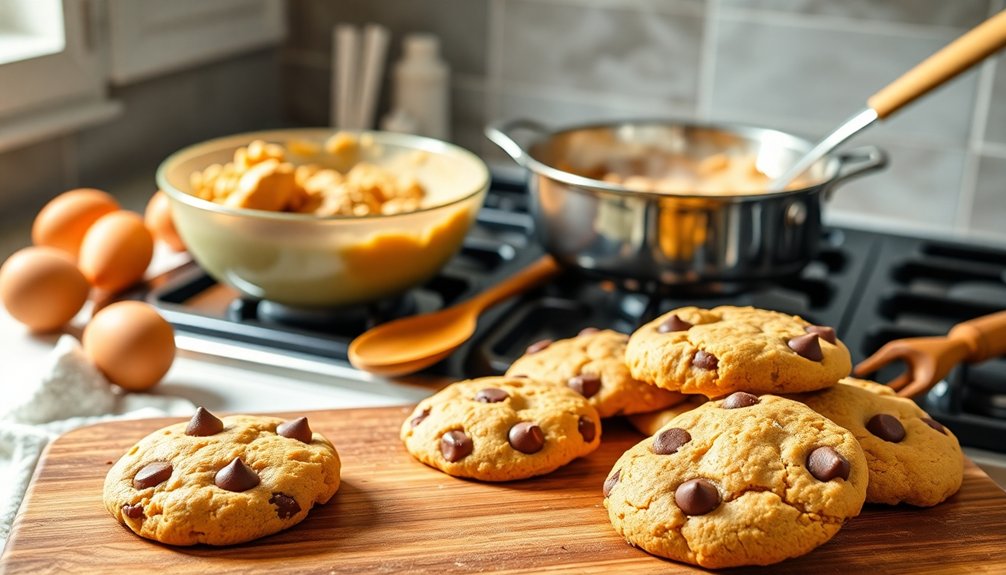
To make stove-top cookies, boil the sugar, butter, milk, cocoa and salt for exactly one minute, then remove the pan from the heat and stir in the peanut butter, vanilla and oats. Scoop the mixture onto parchment and let it cool until set. The steps below follow that order.
- Line a baking sheet or clean counter space with parchment paper.
- In a medium saucepan, combine the sugar, butter, milk, cocoa and salt. Stir over medium heat until the butter melts and the mixture is smooth.
- Bring the mixture to a rolling boil, meaning bubbles keep coming up even while you stir. Boil for exactly one minute, timing it on a clock or timer.
- Remove the pan from the heat. Stir in the peanut butter and vanilla until smooth, then fold in the quick-cooking oats until fully coated.
- Drop heaping spoonfuls onto the parchment, using a cookie scoop or two spoons, and space them slightly apart.
- Let the cookies cool at room temperature for 20 to 30 minutes until they are firm enough to lift without sticking.
What Are the Best Tips for Better Texture?
The most important control is the length of the boil, along with how quickly you scoop after stirring in the oats. Small adjustments in these two areas usually decide whether the cookies are fudgy or dry. The tips below address the most common issues.
How Long Should You Boil the Mixture?
Boil for exactly one minute once the mixture reaches a full rolling boil. A shorter boil can leave the cookies soft and slow to set, while a longer boil can make them dry and hard. Start timing when the boil begins, not when you turn on the burner.
When Should You Scoop the Cookies?
Stir in the oats and scoop while the mixture is still warm but no longer bubbling. If it cools too much, it becomes stiff and hard to shape. If you scoop it while too hot, the cookies may spread and stay soft.
Food Safety: Flour, Eggs and Raw Dough
Stove-top cookies are safe to eat once they have cooled because the sugar mixture is boiled and the recipe uses no raw flour or raw eggs. The concern is with raw cookie dough made from flour and eggs, which is a different product. Keep that distinction in mind if you adapt a recipe.
The U.S. Food and Drug Administration explains that milling grain into flour does not kill harmful bacteria, so cooking is the only reliable way to make foods containing flour and raw eggs safe to eat. The agency’s consumer guidance adds that heat from cooking or baking eliminates bacteria in both flour and the raw eggs commonly used with it, which is why raw cookie dough should not be eaten.
Store-bought cookie dough is made safer through steps home bakers cannot easily copy. A Houston Methodist article on the subject notes that commercial dough uses heat-treated flour and pasteurized eggs, and the article reports the CDC’s advice to say no to raw dough. If you want to add flour or egg to a stove-top recipe, bake the finished cookies or heat-treat the flour first, and do not eat the raw mixture.
How Should You Store Stove-Top Cookies?
Store stove-top cookies in an airtight container at room temperature, and freeze them for longer storage. The sources available for this article give specific shelf lives for baked homemade cookies, not for no-bake cookies, so use the following guidance as a starting point.
| Storage method | Timeframe from source | Notes |
|---|---|---|
| Room temperature, airtight container | 2 to 3 weeks for homemade cookies (University of Nebraska-Lincoln) | The source figure is for baked cookies; no-bake cookies are softer, so check them for texture and freshness before eating |
| Frozen, airtight container | 6 to 12 months for homemade cookies (University of Nebraska-Lincoln) | Freeze in a single layer first, then transfer to a container, and thaw at room temperature |
| Cookie dough at room temperature | Not safe to store (University of Nebraska-Lincoln) | This applies to dough, not finished cookies |
The University of Nebraska-Lincoln food storage guide states that cookie dough is not safe to store at pantry or cupboard room temperature, while homemade cookies keep 2 to 3 weeks at room temperature and 6 to 12 months frozen. Because stove-top cookies are no-bake and softer than baked ones, many home bakers eat them within a few days and freeze any extras.
What Are Good Creative Variations?
The easiest variations change the nut or seed butter, add crunch, or add dried fruit. Keep the base sugar, butter, milk and cocoa ratios the same so the cookies still set correctly. Make one change at a time so you can see how it affects the result.
- Different nut butters: Swap peanut butter for almond, cashew or sunflower seed butter for a different flavor.
- Crunch: Fold in chopped toasted pecans, walnuts or almonds after the oats.
- Dried fruit: Add raisins, dried cherries or chopped dates for chew and sweetness.
- Coconut: Stir in unsweetened shredded coconut for a tropical note.
- Mint: Add a few drops of peppermint extract with the vanilla for a chocolate-mint version.
What Are Common Mistakes and How Do You Fix Them?
Most failed batches come from boiling for the wrong length of time or using the wrong type of oats. Each problem has a clear fix, and the list below covers the most frequent issues.
- Cookies that never set: The boil was likely too short. Boil for a full minute next time once the mixture is at a rolling boil.
- Cookies that are dry or crumbly: The boil may have run too long, or the mixture was left to cool too much before the oats went in.
- Greasy cookies: The peanut butter may have separated. Use a well-stirred creamy style.
- Cookies that spread into flat puddles: The mixture was probably scooped while too hot. Let it cool slightly before dropping.
Frequently Asked Questions
Can You Make Stove-Top Cookies Without Peanut Butter?
Yes, you can use another nut or seed butter, such as almond, cashew or sunflower seed butter. Choose a creamy style so it blends into the hot base. The flavor and texture will change somewhat, so the cookies may need slightly different adjustments.
Why Didn’t My Stove-Top Cookies Set?
The most common cause is a boil that was too short or did not reach a full rolling boil. Boil the mixture for exactly one minute once it is bubbling vigorously. Let the cookies cool for 20 to 30 minutes before you judge the set.
Are Stove-Top Cookies Gluten-Free?
They can be, but only if every ingredient is gluten-free. Oats are naturally free of gluten but are often grown and processed alongside wheat, so look for oats labeled gluten-free. Check the labels on your peanut butter, cocoa and vanilla as well.
Can You Freeze Stove-Top Cookies?
You can freeze them in an airtight container, with parchment between layers if you stack them. University of Nebraska-Lincoln guidance lists 6 to 12 months for homemade cookies frozen, though that figure is for baked cookies. For a related method, see this guide to freezing oatmeal raisin cookies.
Are No-Bake Cookies Safe to Eat Raw?
Stove-top cookies are not raw in the sense of uncooked dough, because the sugar mixture is brought to a boil. They contain no raw flour or raw eggs in a standard recipe. If you add raw flour or raw egg to any no-bake variation, cook it first, because cooking is the only reliable way to make those ingredients safe.
Conclusion
Stove-top cookies give you a fast, oven-free dessert that uses ingredients most kitchens already have. Boil the base for exactly one minute, let the cookies set, and store them in an airtight container. For more quick options, browse these easy dessert recipes you can make in under 30 minutes.