
Measuring 50 grams of butter doesn’t have to be a hassle! Simply use a kitchen scale; it’s the most accurate way to guarantee success in your baking. If you don’t have one, you can estimate by cutting a stick of butter into quarters—three and a half tablespoons is close to 50 grams. Streamlining your prep will enhance your baking experience, so stick around for more handy tips and tricks to make your time in the kitchen easier!
Understanding Butter Measurements
When you’re baking, understanding butter measurements can save you time and guarantee your recipes turn out perfectly. Each pound of butter equals 2 cups, making it easier to measure smaller quantities. If you have a half-pound block, that’s 1 cup, or four sticks, each measuring 1/2 cup. For even more precision, you can cut each stick into 1/4 cup portions or tablespoons—there are 8 tablespoons in a half cup! Knowing these measurements simplifies your baking process. Additionally, using healthier fat swaps can enhance the nutritional profile of your baked goods. Almond sponge cake serves as a great example of how precise measurements contribute to achieving the right texture in baked desserts. Historical butter types may have varied, but modern convenience allows you to master these techniques for efficiency and accuracy. Properly measured dry ingredients are also vital for achieving the right texture and rise in cookies.
The Importance of Accurate Baking
Accurate baking hinges on precise measurements, as even slight variations can lead to disappointing results in texture and flavor.
When you measure ingredients like 50g of butter, you’re ensuring baking consistency, which is essential for a successful outcome. A kitchen scale is your best friend here; it removes the guesswork that can come with volume measurements. The invention of chocolate chip cookies exemplifies how precise measurements can lead to delicious results. Additionally, using sugar-free sweeteners can help you maintain a healthier baking approach without compromising taste.
Remember, 50g is about 11% of a pound, so if you’re scaling recipes, you can easily adjust your quantities. Understanding the conversion between grams and cups can also simplify your adjustments, making it easier to follow any recipe. Familiarity with butter measurements, like sticks or tablespoons, speeds up your prep and enhances your baking efficiency. Additionally, precise measurements are crucial for creating desserts like Norwegian Kransekake that rely on specific ratios for optimal texture and flavor.
How to Cut a Butter Block
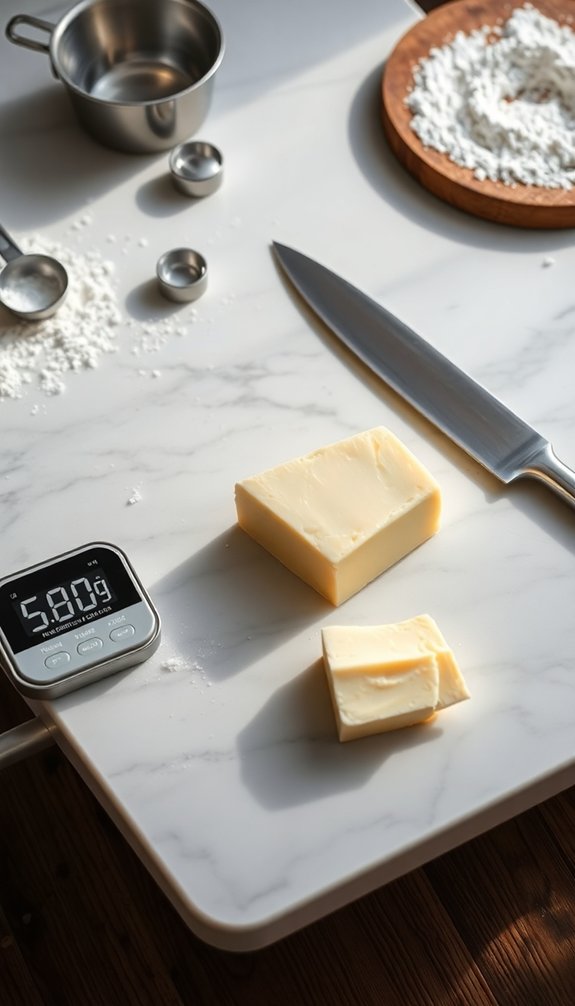
Cutting a butter block doesn’t have to be complicated. By visualizing the standard cuts, you can easily measure out specific amounts like 50g without a kitchen scale. Let’s explore some straightforward techniques to make butter measuring a breeze. Additionally, using high-quality ingredients can greatly enhance the flavor of your baked goods. For instance, opting for cream cheese frosting can elevate the richness of your desserts. Furthermore, incorporating high-protein snacks can provide sustained energy for your baking endeavors.
Measuring Techniques Simplified
While baking, measuring butter accurately can make all the difference in your recipes. To measure 50g of butter, start with a pound block, which equals 2 cups or 454g. Cut the block in half to get 1 cup (about 227g), then divide it further.
Each stick represents 1/2 cup (113g), so you’ll need slightly less than half a stick for 50g. For precision, remember that each tablespoon of butter is approximately 14g, so 50g is about 3.5 tablespoons.
Using measuring tools like a scale or tablespoon helps guarantee accuracy. Proper butter storage is essential too; keep it wrapped tightly to maintain freshness and make cutting easier when you’re ready to measure.
Visualizing Butter Cuts
When you need to measure butter for your baking, visualizing how to cut a standard 1-pound block can simplify the process.
Start by cutting the block into 16 equal pieces, where each piece is about 28.35g. For your 50g measurement, use two pieces for close accuracy.
Each half of the block equals 1 cup, easily divided into four sticks, each stick being 1/2 cup or 113g. For precise butter portioning, consider cutting each stick into four equal parts, giving you 1/4 cup or roughly 57g.
If you prefer tablespoons, remember that 1 tablespoon equals about 14g, so you can measure 50g using about 3.5 tablespoons.
This visual measurement method enhances your baking efficiency.
Converting Butter Measurements
Measuring butter accurately is essential for achieving the best results in your baking, especially when dealing with specific quantities like 50 grams. Julekage bread is a delightful recipe where precise measurements can enhance the overall flavor and texture.
Different butter types may require varying approaches, but here are three handy conversion methods to help you out:
- Cut a stick: A standard stick of butter weighs 113 grams. Halving it gives you about 56.5 grams; trim a small piece to reach 50 grams.
- Use tablespoons: Since each tablespoon weighs around 14 grams, measure out approximately 3.5 tablespoons for 50 grams.
- Know your cups: 50 grams is roughly 1/4 cup plus 2 tablespoons, as 1 cup equals about 227 grams.
Utilizing the right measuring tools will guarantee your recipes turn out perfectly! Additionally, keeping butter cold during preparation is important for achieving a flaky texture in your baked goods.
Using a Kitchen Scale for Precision
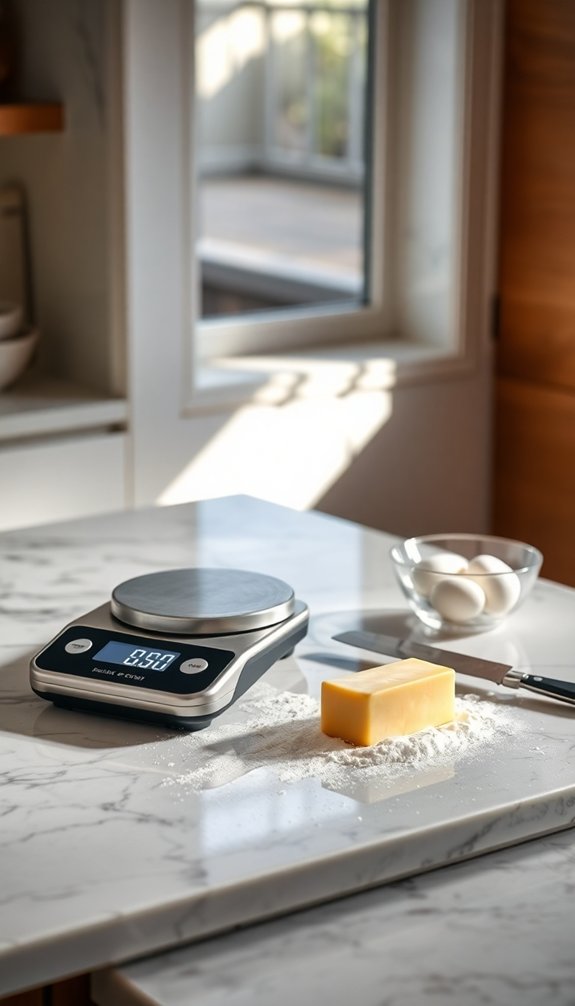
When you’re baking, accurate measurements are key to achieving consistent results. Using a kitchen scale makes it easy to weigh butter precisely, ensuring you use exactly 50g every time. This precision is especially important when working with gluten-free ingredients, as small variations can affect the texture and flavor of your baked goods. Additionally, using a scale can help you incorporate natural sweeteners effectively, which can enhance the flavor profile of your recipes while reducing overall sugar intake. Each ingredient’s culinary diversity can significantly influence the final outcome, making precise measurements even more crucial.
Importance of Accurate Measurements
Accurate measurements are essential in baking, as even minor discrepancies can drastically alter the texture and flavor of your creations.
Using a kitchen scale guarantees precision in baking, allowing you to measure ingredients like butter in grams for exact amounts, such as 50 grams.
Here are three reasons why accuracy matters:
- Consistency: Weighing ingredients helps maintain uniform results across different batches.
- Quality: Professional bakers rely on weight measurements to enhance the overall quality of their recipes.
- Elimination of Guesswork: A scale removes the uncertainty of converting volume measurements, which can vary by ingredient density.
Steps to Weigh Butter
To get the perfect amount of butter for your recipe, start by placing a clean bowl on your kitchen scale and zeroing it out. This guarantees accuracy in your measurements.
Next, add the butter until the scale reads 50 grams. If you’re using weighing techniques, this method is far superior to volume measurements, which can lead to discrepancies.
Remember, 50 grams is about 1/8 of a cup or slightly less than a stick of butter—just under 113 grams.
If you don’t have a scale, consider cutting a stick in half, then into smaller pieces.
If you’re looking for butter alternatives, keep in mind that many can be weighed similarly to achieve precise amounts in your baking.
Easy Ways to Measure 50g of Butter
Measuring 50g of butter can be a breeze if you know a few handy tricks.
Whether you’re using butter storage methods or searching for baking substitutes, these tips will help you get it right every time:
- Cut a Stick: Since one stick weighs 113g, cut it in half and estimate slightly less than half for 50g.
- Use Tablespoons: Knowing that 1 cup (227g) contains 16 tablespoons, measure out about 4 tablespoons to achieve 50g.
- Kitchen Scale: For precise measuring, place the butter on a kitchen scale until it reads 50g.
Additionally, consider incorporating healthier ingredient swaps to make your baked goods more nutritious while enjoying the holiday season.
These simple techniques make it easy to measure butter accurately, ensuring your baked goods turn out perfectly!
Tips for Dividing Sticks of Butter

Once you’ve mastered measuring 50g of butter, it’s time to explore how to divide sticks of butter with ease. A standard stick weighs about 113 grams, so you can cut it into roughly 7/16 for your 50-gram need.
To simplify butter portioning, slice the stick in half for a quick 57 grams, then trim a bit off to hit your target. Remember, each tablespoon equals about 14 grams, so measuring out 3.5 tablespoons is another handy method.
For the most accurate results, use a kitchen scale to weigh the butter directly. This guarantees your baking consistency stays on point, making your recipes turn out perfectly every time.
Happy baking!
Common Butter Measurement Conversions
Understanding common butter measurement conversions can make your baking experience smoother and more accurate.
Here are a few key conversions to keep in mind when using different butter types:
- To measure 50 grams of butter, use about 3.5 tablespoons, as each tablespoon weighs roughly 14 grams.
- A standard stick of butter weighs 113 grams, so cutting it in half gives you approximately 56.5 grams, which you can adjust to reach 50 grams.
- Remember that 1 cup of butter equals 227 grams, meaning 50 grams is about 1/4 cup plus a tablespoon.
Practical Baking Hacks for Success

Baking isn’t just about following recipes; it’s also about having a few clever tricks up your sleeve to assure success.
To measure 50 grams of butter accurately, consider using a kitchen scale, as it guarantees precise measurements. If you don’t have a scale, remember that 50 grams is roughly 3.5 tablespoons or a bit less than 1/5 cup. Familiarize yourself with the visual cuts in a butter block to help you estimate amounts quickly.
For effective ingredient storage, keep your baking tools organized, so you can easily grab what you need. By mastering these practical hacks, you’ll streamline your baking process and avoid common pitfalls, leading to delicious results every time.
Enhancing Your Baking Efficiency
While you may have your favorite recipes down pat, enhancing your baking efficiency can elevate your results even further.
Here are three simple strategies to streamline your baking organization and ingredient prep:
- Use a Kitchen Scale: Invest in a good kitchen scale for accurate measurements. This guarantees you get 50g of butter right every time and improves consistency in your baking.
- Pre-Portion Ingredients: Cut a pound block of butter into manageable portions. This makes it easier to grab the right amount without fussing over conversions.
- Familiarize Yourself with Measurements: Knowing that just under half a stick equals 50g can greatly cut down your prep time and reduce errors.
With these tips, you’ll find yourself baking more efficiently and enjoying the process even more!
Conclusion
In baking, getting your butter measurements right can make all the difference. With these handy tips and tricks, you’ll be able to measure 50g of butter without breaking a sweat. Remember, practice makes perfect, so don’t be afraid to experiment and find what works best for you. Before you know it, you’ll be whipping up delicious treats like a pro, turning your kitchen into a haven of sweet success. Happy baking!