
Last updated: · By Claire Dawson
You can make an easy croissant recipe without yeast by using baking powder as the leavening agent and folding cold butter into the dough. The hands-on work takes about 30 minutes, and most of the remaining time is chilling. The result is a tender, flaky pastry that is closer to puff pastry than to a traditional yeasted croissant, which is a useful way to set your expectations.
Key Takeaways
- A yeast-free croissant uses baking powder for lift, so it skips the proofing time that yeasted doughs need.
- Most baking powder is double-acting, releasing gas once when liquid is added at room temperature and again when the batter reaches about 140°F (60°C), according to the Illinois State Board of Education.
- Puff pastry contains no yeast, so a yeast-free croissant behaves more like puff pastry than like Danish or traditional croissant dough, which uses yeast.
- Keep the butter and dough cold throughout, and chill the dough for at least 30 minutes between folds to keep the butter in distinct layers.
- Bake at 400°F (200°C) for about 15 to 20 minutes, until the croissants are deep golden brown.
What Is a Yeast-Free Croissant?
A yeast-free croissant is a laminated pastry made with baking powder instead of yeast. Laminated means the dough is layered with cold butter through repeated rolling and folding, and those butter layers create the flaky texture when they melt and steam in the oven.
Traditional croissants depend on yeast to create a light, open crumb, and they need long proofing. A yeast-free version swaps that rise for chemical leavening, so the dough is ready to shape much sooner. The trade-off is a less airy, more tender crumb.
The leavening works differently too. A USDA Agricultural Marketing Service technical report on sodium bicarbonate and baking powder handling explains that double-acting baking powder combines a leavening base, two leavening acids, and a carrier such as cornstarch. That formulation is why it can work as a chemical leavener in doughs without yeast.
How Does the Yeast-Free Method Compare?
The table below compares a yeast-free croissant with a traditional yeasted croissant and with puff pastry. Puff pastry is the closest match in method, since it also relies on butter layers and has no yeast.
| Feature | Yeast-free croissant | Traditional yeasted croissant | Puff pastry |
|---|---|---|---|
| Leavening | Baking powder | Yeast | Steam from butter (no yeast) |
| Rise time | None; chilling only | Long proofing period | None; chilling only |
| Hands-on time | About 30 minutes | Often longer, with several rises | Moderate, with repeated folds |
| Crumb | Tender and flaky, less open | Light, airy, honeycomb-like | Flaky, layered, crisp |
Easy Croissant Recipe Without Yeast: Ingredients
This recipe makes about 12 croissants and uses common pantry ingredients plus two portions of cold butter. Weigh the flour if you can, since scooped flour varies widely in weight.
- 2½ cups (315 g) all-purpose flour
- 1 tablespoon (12 g) granulated sugar
- 1 teaspoon fine salt
- 1½ teaspoons baking powder
- 4 tablespoons (57 g) cold unsalted butter, cut into small cubes, for the dough
- 8 tablespoons (113 g) cold unsalted butter, for the butter block
- About ¾ cup (180 ml) ice-cold water, added gradually
- 1 egg beaten with 1 tablespoon water, for egg wash
Use unsalted butter so you control the salt level. Choose a firm, high-fat butter stick if you can. Plant-based butter sticks vary in water and fat content and can behave differently in laminated dough, so expect a different result if you use them.
Tools You Need
You need only basic equipment to make this recipe. A rolling pin, a bench scraper, parchment paper, and a sharp knife or pizza cutter are the essentials.
- Rolling pin and bench scraper
- Two large sheets of parchment paper
- Baking sheet lined with parchment
- Pastry brush for egg wash
- Plastic wrap or a clean towel to cover the dough
- Instant-read or oven thermometer to confirm oven temperature
How to Make an Easy Croissant Recipe Without Yeast
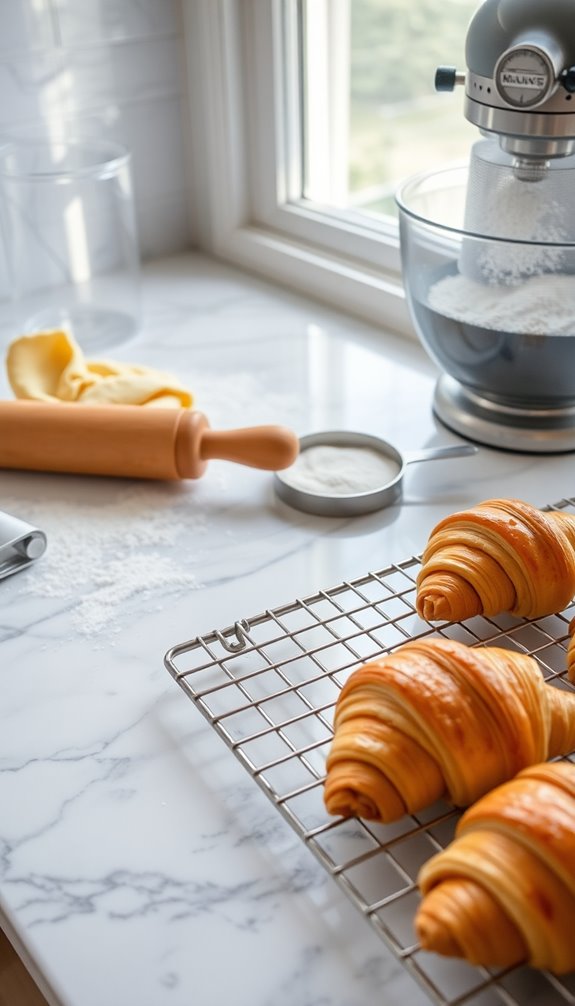
The method has four stages: mix the dough, fold in the butter block, shape the croissants, and bake. Keep the kitchen cool and work quickly so the butter stays firm.
Step 1: Mix the Dough
- Whisk the flour, sugar, salt, and baking powder together in a large bowl.
- Add the 4 tablespoons of cold butter and rub it in with your fingertips until the mixture looks mostly like coarse crumbs with some pea-sized pieces.
- Add the ice-cold water a tablespoon or two at a time, mixing with a fork, until a shaggy dough forms. You may not need all of it.
- Gather the dough into a 6-inch square, wrap it in plastic, and refrigerate for at least 30 minutes.
Step 2: Fold in the Butter Block
- Pound the 8 tablespoons of cold butter between two sheets of parchment into a rectangle about 6 inches by 4 inches and ½ inch thick. Chill it until firm but pliable.
- Roll the chilled dough into a rectangle about 12 inches by 8 inches. Place the butter block on one half, then fold the other half over it and pinch the edges closed.
- Roll the packet gently into a rectangle about 12 inches by 8 inches, keeping the edges as straight as possible.
Step 3: Laminate With Letter Folds
- Fold the rectangle into thirds like a letter: bring the bottom third up, then fold the top third down over it.
- Turn the dough a quarter turn so the folded edge is on your left, then roll it out to about 12 by 8 inches again.
- Repeat the letter fold, wrap the dough, and chill it for 30 minutes. Do this three times in total, chilling between each fold.
Each fold adds more layers of butter and dough. Chilling between folds keeps the butter from softening into the dough, which is what keeps the layers separate.
Step 4: Shape the Croissants
- After the final chill, roll the dough into a rectangle about ¼ inch (6 mm) thick. Trim the edges with a sharp knife.
- Cut the rectangle into triangles with a base about 4 inches wide. Make a small slit in the center of each base, which helps the croissant roll up evenly.
- Roll each triangle from the base toward the tip, stretching it slightly, then tuck the point underneath. Curve the ends in to form a crescent.
- Place the croissants seam side down on the lined baking sheet, spaced at least 2 inches apart. Cover loosely and chill for 15 minutes while the oven heats.
Step 5: Bake Until Deep Golden
- Heat the oven to 400°F (200°C) and place a rack in the center.
- Brush the croissants lightly with the egg wash, taking care not to let it drip down the sides, which can seal the layers.
- Bake for 15 to 20 minutes, rotating the pan halfway through, until the croissants are deep golden brown.
- Cool on a wire rack for at least 10 minutes before serving so the layers set.
Common Problems and Fixes
Most problems with yeast-free croissants come from butter that softened too much or dough that was overworked. Start by checking the temperature of the butter and dough before you troubleshoot anything else.
Why Are My Layers Not Distinct?
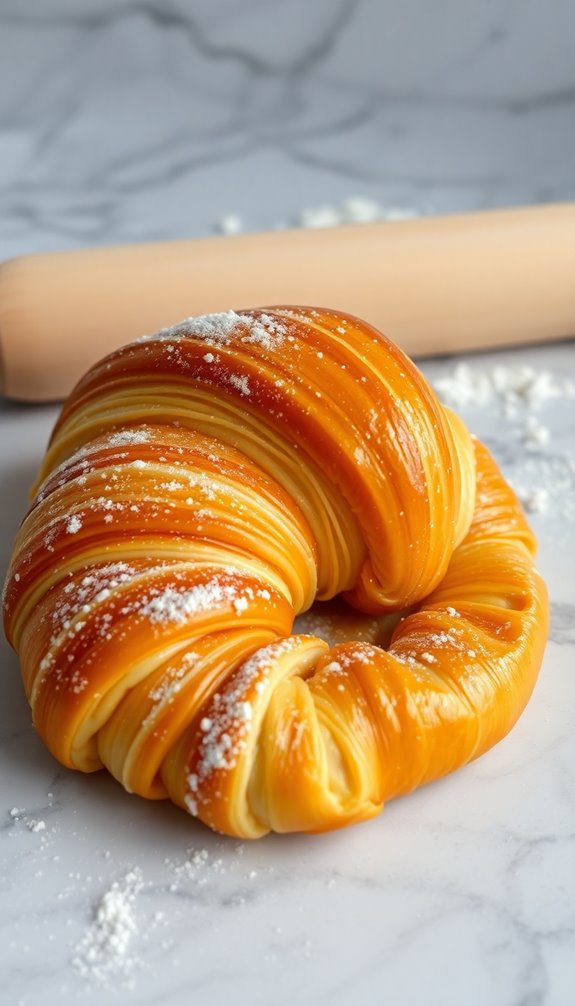
Layers usually merge when the butter melts into the dough during rolling. Chill the dough for 30 minutes whenever it feels soft or sticky, and work in a cool kitchen. If the dough becomes greasy, stop and refrigerate it before continuing.
Why Is My Dough Tough?
Tough dough usually comes from overworking the flour. Mix the water in only until the dough holds together, and avoid kneading it. Gluten, the protein network that forms when flour is mixed with water, toughens the dough when it is overdeveloped.
Why Did My Croissants Come Out Flat?
Flat croissants often mean the baking powder has lost strength or the dough was rolled too thin or too thick. Check that your baking powder is fresh, since it loses leavening power over time. Roll to the recommended ¼ inch so the layers have enough dough to puff.
Why Are They Browning Too Fast?
Egg wash and sugar brown quickly, so an oven that runs hot can overbrown the exterior before the center is set. Check the oven with a thermometer, and tent the croissants loosely with foil if the tops darken before the layers finish baking.
Storage and Make-Ahead Tips
Baked croissants are best the day they are made, and you can extend their life with careful storage. Store cooled croissants in an airtight container at room temperature for up to 2 days. Refrigeration dries them out and softens the layers.
- Refrigerate the dough for up to 2 days, wrapped tightly, before shaping and baking.
- Freeze shaped, unbaked croissants on a tray until firm, then move them to a freezer bag for up to 1 month. Bake them straight from frozen, adding a few minutes to the baking time.
- Freeze fully cooled baked croissants in a single layer, then wrap them well for up to 1 month. For more on freezing sweet baked goods, see our guide on freezing oatmeal raisin cookies.
- Reheat thawed baked croissants in a 350°F (175°C) oven for 5 to 8 minutes until warm and crisp.
Serving Ideas for Yeast-Free Croissants
These croissants work well at breakfast and at casual gatherings. Their tender, buttery crumb pairs well with both sweet and savory toppings.
- Serve warm with fruit preserves, honey, or softened butter.
- Split and fill with scrambled eggs and cheese for a quick breakfast sandwich.
- Offer a platter with herbed goat cheese, sliced ham, and fresh berries for brunch.
How Do They Compare With Other Sweet Breads?
Yeast-raised breads have a different structure and rise. For a yeast-raised sweet dough, see our authentic kolache bread recipe, which shows how yeast builds a soft, pillowy crumb.
Frequently Asked Questions
Can You Make Croissants Without Yeast?
Yes. You can make croissant-style pastry without yeast by using baking powder for lift and folding cold butter into the dough. The result is flaky and buttery, but it has a more tender, less airy crumb than a traditional yeasted croissant.
Why Does This Recipe Use Baking Powder?
Baking powder provides the gas that lifts the dough without yeast. Most baking powder is double-acting, meaning it releases gas once when liquid is added and again when the dough heats in the oven. That second release helps the pastry rise during baking.
Can I Use Margarine Instead of Butter?
You can try it, but results will differ. Butter provides the solid fat that creates separate layers, and margarine and plant-based sticks vary in fat and water content. Choose a firm, high-fat, cold stick of butter for the most reliable layers.
Why Didn’t My Croissant Dough Form Distinct Layers?
The butter most likely warmed and blended into the dough. Keep the dough and butter cold, chill the dough for 30 minutes between folds, and work quickly in a cool kitchen. Stop and refrigerate the dough whenever it feels soft.
Can I Make the Dough Ahead?
Yes. You can refrigerate the laminated dough for up to 2 days before shaping and baking. You can also freeze shaped, unbaked croissants for up to 1 month and bake them straight from frozen.
Conclusion
This easy croissant recipe without yeast gives you flaky, buttery pastries with far less waiting than a traditional yeasted croissant. The key is cold butter, chilled dough between folds, and a hot oven at 400°F (200°C). Once you have the method down, try it for weekend breakfasts and treat it as a practical shortcut to flaky layers, as you would a laminated puff-style pastry.